
Holiday Traditions Trivia Quiz
Coca-Cola did not invent the modern image of Santa Claus. The company's 1930s advertising campaign (illustrated by Haddon Sundblom) standardized and popularized a red-suited, white-bearded, jolly Santa - but similar depictions appeared in print decades earlier, and the physical template was largely set by the 1890s. The name 'Santa Claus' derives from Sinterklaas, the Dutch form of Saint Nicholas of Myra - a real 4th-century bishop, famous for secretly giving gifts to the poor.
Halloween was not invented by American commercial interests. Its roots are Celtic: Samhain (pronounced 'SAH-win') was the harvest festival marking the end of summer, when the veil between the living and the dead was believed to be thinnest. When the Catholic Church absorbed Celtic territories, November 1st became All Saints' Day and October 31st became All Hallows' Eve - Halloween. The tradition arrived in America primarily with Irish immigrants during the famine migration of the 1840s; commercial trick-or-treating didn't become widespread until the 1950s.
Christmas trees predate Christianity in Germanic winter-solstice tradition. The modern English-language custom was popularised by a single illustration: an 1848 engraving of Queen Victoria and Prince Albert (German-born) around a decorated tree, published in the Illustrated London News, made Christmas trees fashionable in Britain and America almost immediately. The Chinese New Year date changes annually because it follows the lunisolar calendar - specifically, the second new moon after the winter solstice - a tradition traced to at least the Shang Dynasty (~14th–11th century BCE).
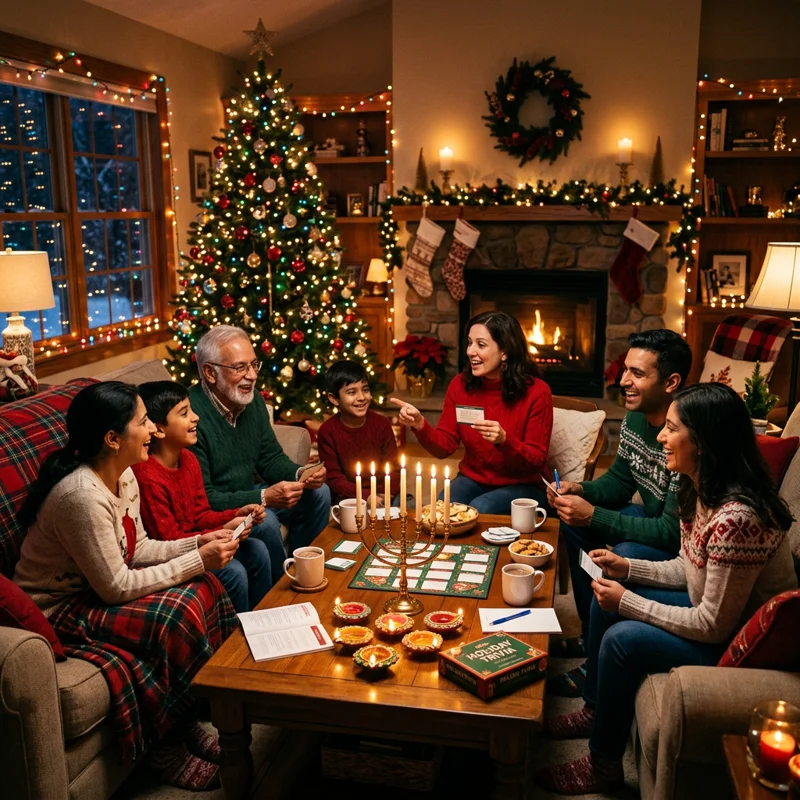
This quiz covers 12 questions spanning Christmas, Diwali, Hanukkah, Eid, Halloween, Día de los Muertos, and other major celebrations - testing knowledge and the often-surprising gap between mythology and documented history.
Key Takeaways
- •Christmas trees were popularized in the English-speaking world by Prince Albert of Saxe-Coburg and Gotha, who introduced the tradition from Germany to the British royal court in 1841.
- •Diwali - the Festival of Lights - is celebrated by Hindus, Sikhs, Jains, and some Buddhists, each for different historical and religious reasons.
- •Hanukkah is often called the 'Festival of Lights' and involves the lighting of the menorah over eight nights, commemorating the miracle of oil in the Second Temple.
- •Thanksgiving in the United States is celebrated on the fourth Thursday in November - Canada celebrates its own Thanksgiving on the second Monday of October.
- •The Day of the Dead (Día de los Muertos) is a Mexican tradition rooted in Aztec practices combined with Catholic influence, celebrating deceased loved ones with colorful altars and marigolds.
How Holidays Shape Culture
What a culture chooses to celebrate tells you what it values. A harvest festival values community and abundance. A remembrance day values sacrifice and history. A religious feast values the sacred and the transcendent. Studying holiday traditions across cultures is one of the most efficient ways to understand what different societies hold dear - and how those values persist and change across generations.
The Surprising Origins of Holiday Traditions
The modern Santa Claus is a composite figure. The name derives from Sinterklaas (Dutch for Saint Nicholas), a 4th-century Christian bishop known for secretly giving gifts to the poor. The red suit and jolly belly image was popularized by Coca-Cola's 1930s advertising campaigns - though similar red-suited Santas appeared in illustrations before Coca-Cola's version.
Christmas trees were popularized in England by Prince Albert (German-born consort of Queen Victoria) in the 1840s. A widely circulated illustration of Victoria, Albert, and their children around a decorated tree made Christmas trees fashionable across Britain and America almost immediately.
Halloween's origins are Celtic: Samhain (pronounced 'SAH-win') was a festival marking the end of harvest season when the boundary between the living and dead was believed to be at its thinnest. When the Catholic Church absorbed Celtic regions, Samhain was reframed as All Hallows' Eve (the eve of All Saints' Day on November 1st).
The Chinese New Year date changes annually because it's based on the lunisolar calendar - specifically, the second new moon after the winter solstice. The festival itself dates to at least the Shang Dynasty (~14th–11th century BCE), making it one of the oldest continuously observed holidays in human history.
Frequently Asked Questions
What is the most celebrated holiday in the world? Christmas is observed by approximately 2 billion people across Christian and secular contexts worldwide - more than any other single holiday. Diwali (the Hindu Festival of Lights) is celebrated by approximately 1 billion people. Eid al-Fitr (celebrating the end of Ramadan) is observed by approximately 1.8 billion Muslims globally.
What country has the most unique holiday traditions? Japan is frequently cited for its uniquely transformed holidays: Christmas (celebrated primarily as a romantic/commercial holiday with KFC as the traditional Christmas meal - a marketing campaign that became a genuine tradition), Valentine's Day (women give chocolates to men, with a separate 'White Day' for reciprocation a month later).
Why do holiday traditions differ so much between countries? Holiday traditions are shaped by the intersection of religious calendar, agricultural cycles, geographic climate, local pre-existing customs, and commercial evolution. The same holiday (Christmas, New Year, Easter) often looks dramatically different across countries based on which of these factors dominated local tradition-formation.
Comments
Leave a comment