
What Music Genre Are You?
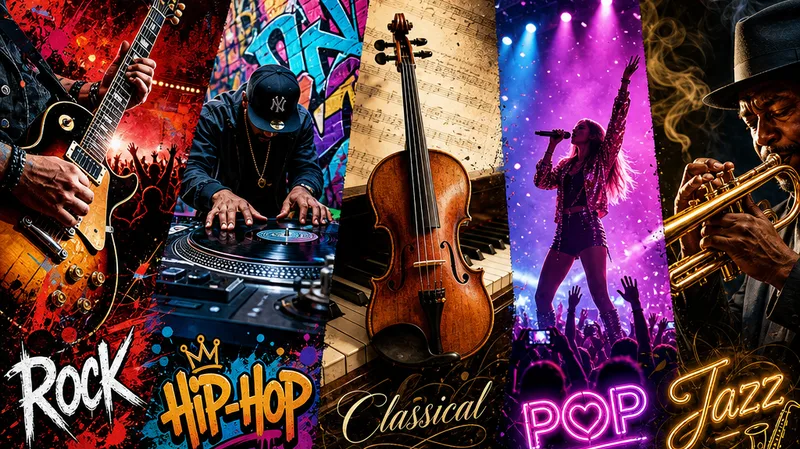
Your music taste is one of the most reliable windows into your personality. Research by Peter Rentfrow and Samuel Gosling (2003) - one of the most widely cited studies in music psychology - found that the music people gravitate toward correlates strongly with their Big Five personality traits: openness, conscientiousness, extraversion, agreeableness, and neuroticism. Genre preference isn't just aesthetic; it's autobiographical.
Pop, hip-hop, rock, R&B/soul, and country represent five distinct emotional and social frameworks. Pop is optimism and collectivity. Hip-hop is rhythm, expression, and cultural urgency. Rock is independence and authenticity. R&B is emotional depth and groove. Country is storytelling, roots, and community. These aren't just sounds - they're orientations toward life.
This quiz asks 12 questions about how you feel, connect, and move through the world. Find out which genre is your personality's home.
Key Takeaways
- •Psychologist Peter Rentfrow's 2003 study found that music preferences correlate reliably with Big Five personality traits - particularly openness to experience and extraversion.
- •Hip-hop/rap became the best-selling genre in the United States sometime in the mid-2010s, surpassing rock for the first time in genre chart history.
- •Country music's storytelling tradition dates back to Appalachian folk music and blues, and its emphasis on narrative over abstraction distinguishes it psychologically from most other popular genres.
- •Research suggests that people high in openness to experience tend to prefer blues, jazz, classical, and folk, while those high in extraversion tend to prefer pop and hip-hop.
- •R&B (Rhythm and Blues) originated in African American communities in the 1940s, fusing gospel, jazz, and blues - and its emotional directness and vocal emphasis remain central to the genre's psychological appeal.
The Science of Music Genres and Personality
The connection between music and personality has been studied seriously since the early 2000s, when Peter Rentfrow and Samuel Gosling published 'The Do Re Mi's of Everyday Life' (Journal of Personality and Social Psychology, 2003). They found that music preferences clustered into four dimensions: Reflective & Complex (classical, jazz, folk), Intense & Rebellious (rock, heavy metal), Upbeat & Conventional (pop, country, religious), and Energetic & Rhythmic (hip-hop, soul, funk).
These dimensions correlated reliably with personality. Reflective & Complex listeners scored higher on openness and intelligence. Intense & Rebellious listeners were high in openness but lower on agreeableness. Upbeat & Conventional listeners tended toward extraversion and high conscientiousness. Energetic & Rhythmic listeners were high in extraversion and agreeableness.
More recent research has refined and complicated these findings - genre boundaries have blurred significantly in the streaming era, and most people's listening is more hybrid than the original framework assumed. But the core insight holds: the music you're drawn to tells you something real about how you process the world.
What Your Genre Says About You
Pop listeners tend toward optimism, social connectivity, and a desire for shared emotional experience. Pop's formal structures - verse, chorus, bridge - are designed to create communal moments, and listeners drawn to them tend to be oriented toward relationship and belonging.
Hip-hop listeners tend toward expressiveness, cultural awareness, and a strong orientation toward rhythm as communication. The genre's emphasis on lyricism and flow rewards close listening and verbal intelligence, and hip-hop's social and political content attracts those with a strong sense of cultural identity.
Rock listeners tend toward independence, intensity, and authenticity-seeking. Rock's historical association with rebellion and individual expression attracts those who value originality over convention, and who find the loudness and distortion emotionally cathartic.
R&B and soul listeners tend toward emotional depth, sensuality, and a groove-first relationship with music. R&B requires the body as much as the mind - it's music felt before it's analysed. Listeners drawn to it tend toward high emotional intelligence and a preference for music as an embodied rather than intellectual experience.
Country listeners tend toward storytelling, rootedness, and community. Country songs are almost universally narrative - they tell specific stories about specific people - and listeners drawn to this tend to value tradition, place, and the kind of wisdom that comes from close observation of particular lives.
Frequently Asked Questions
What is the most popular music genre? Globally, pop remains the most widely consumed genre by total streams. In the United States, hip-hop/rap has been the best-selling genre by sales and streams for several years. Country is the most listened-to genre in the American South and Midwest and has seen significant global growth in recent years.
Can personality predict music taste? Research suggests personality can predict broad genre preferences with above-chance accuracy, but individual taste is shaped by many factors beyond personality - family, geography, social group, first listening experiences, and pure chance all play significant roles. Personality is a predictor, not a determinant.
Is genre dead in the streaming era? Genre as a rigid category is less meaningful in the streaming era - artists like Tyler, the Creator, Billie Eilish, and Beyoncé regularly blend genre conventions in ways that resist simple classification. However, genre as a shorthand for emotional and social orientation remains useful, both for listeners navigating streaming catalogues and for researchers studying music and psychology.
Comments
Leave a comment