
Which Decade Do You Belong In?
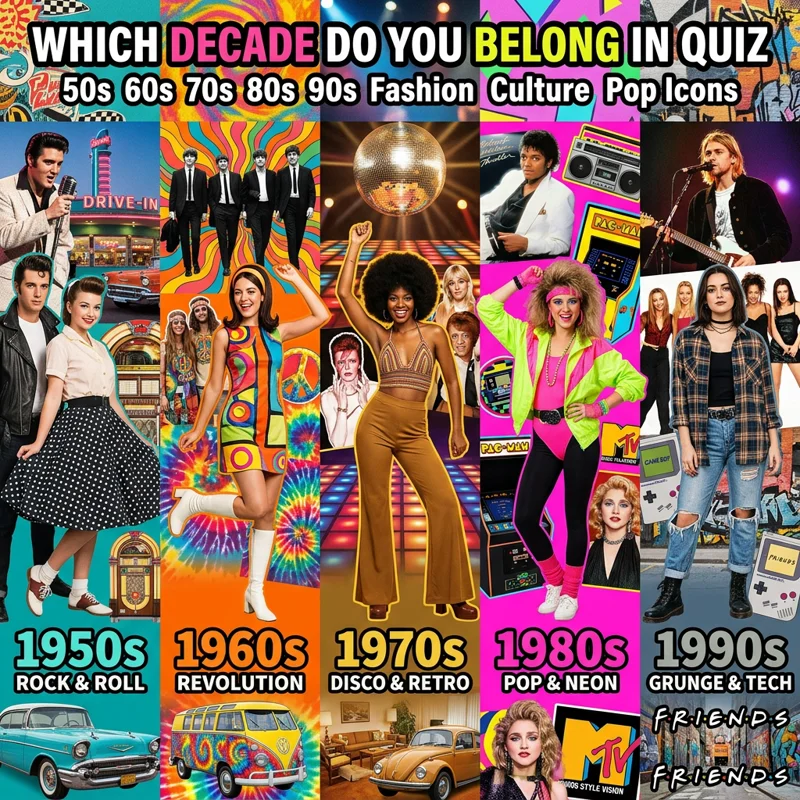
Nostalgia researchers at the University of Southampton found that people feel strongest nostalgia for the years between ages 12 and 25 - and that music heard during those years triggers the most vivid emotional recall of any sensory cue.
The 1980s consistently ranks as the most nostalgized decade in pop culture, driving everything from synthwave revivals to the aesthetic engine behind Stranger Things - while Gen Z has simultaneously embraced 90s grunge and early 2000s Y2K fashion as their own.
Answer these 10 questions to find out which decade you truly belong in.
Key Takeaways
- •Nostalgia research shows that people most strongly nostalgize for the decade they experienced between ages 12–25, even if they weren't alive for it - a phenomenon called 'media nostalgia.'
- •Each generation inherits aesthetic preferences from earlier decades through music, fashion, and film - explaining why Gen Z has embraced 90s and Y2K aesthetics.
- •Decade nostalgia is often triggered by sensory cues: a song, a fashion piece, or a food can instantly transport someone to a different era.
- •The 1980s consistently ranks as the most nostalgized decade in pop culture, driven by film, music, and a distinctive color palette that has never fully gone away.
- •Aesthetic movements on social media (cottagecore, Y2K, 70s boho) reflect genuine cross-generational attraction to specific decade aesthetics.
Why We're Drawn to Different Decades
Every decade carries a distinct cultural fingerprint - its own sounds, aesthetics, social values, and technological landscape. The 1950s offered optimism and conformity after wartime hardship; the 1970s brought grit, freedom, and complexity; the 1980s exploded with excess, neon, and ambition; the 1990s offered irony, independence, and authenticity; the 2000s blended analog nostalgia with the dawn of digital life. The decade that resonates with you reflects your own values and aesthetic instincts more than the year you were born.
Decade Aesthetics at a Glance
1950s: Poodle skirts, drive-ins, diners, rock 'n' roll, optimism, and a clear (if rigid) social order. You love civility, classics, and the elegance of simplicity.
1970s: Bell-bottoms, vinyl records, road trips, earth tones, liberation movements, and soulful music. You value authenticity, freedom, and depth over polish.
1980s: Power suits, synth pop, big hair, arcades, and unapologetic ambition. You're bold, energetic, and you don't do things halfway.
1990s: Flannel, CDs, Saturday morning cartoons, Tamagotchis, and a sense that everything was ironic but also kind of heartfelt. You're laid-back, creative, and deeply nostalgic.
2000s: Low-rise jeans, flip phones, early internet, pop radio, and a peculiar mix of innocence and excess. You love both analog warmth and digital novelty.
The Science of Nostalgia
Constantine Sedikides and Tim Wildschut at the University of Southampton have extensively studied nostalgia and found it serves a protective function: it reinforces self-continuity, boosts positive mood, and increases social connectedness. When you feel drawn to a particular decade, you're often drawn to what it represents emotionally - a simpler time, a greater sense of community, or a bolder aesthetic that resonates with your own self-image.
Frequently Asked Questions
Which decade do most people feel they belong in? In personality surveys, the 1950s and 1960s attract people who value community, simplicity, and optimism; the 1970s attract free-spirited, counterculture-oriented personalities; the 1980s attract bold, ambitious, and aesthetically maximalist personalities; the 1990s attract those who value authenticity and pre-digital connection. The 2000s and earlier decades appeal most to those who grew up in them.
What decade had the best quality of life? This depends heavily on demographics. The 1950s are often romanticized but were deeply restrictive for women, LGBTQ+ people, and non-white Americans. The 1990s had high economic growth, low crime, and pre-social-media social life, making them frequently cited as a 'golden era' by those who experienced them as young adults. Quality of life is inseparable from who you were in that decade.
What does it mean if I relate most to a different era than I was born in? Strong identification with a different historical era often reflects a mismatch between your values or temperament and the cultural norms of your actual time. People who feel they belong in the past typically value community, craftsmanship, and face-to-face connection. People who feel ahead of their time tend to be highly comfortable with change and ambiguity.
Comments
Leave a comment