
Color Blind Test
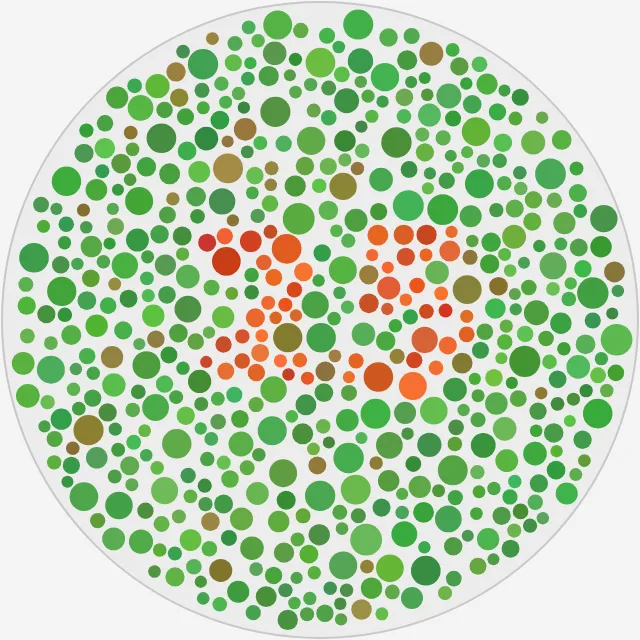
A color blind test checks whether your eyes can distinguish between shades by presenting Ishihara plates - circles of colored dots that hide a number only people with normal color vision can read easily.
If your color-sensing cone cells aren't all working correctly, certain colors blend together and the hidden number becomes faint or invisible. The most common form affects red-green discrimination and is far more common in men (around 1 in 12) than in women (about 1 in 200).
This version uses 20 Ishihara-style plates and gives you an instant score the moment you finish. Tap "Start Quiz" whenever you're ready.
Related Articles
Key Takeaways
- •1 in 12 men and 1 in 200 women are born with some form of color vision deficiency.
- •Red-green color blindness is the most common type and is inherited, not acquired.
- •Ishihara plates - the dot-pattern images in this quiz - have been the clinical gold standard since 1917.
- •Most color-blind people are unaware of their condition until they fail a formal test.
- •Color blindness cannot be cured, but it rarely affects quality of life or career prospects.
How does a color blind test work?
These are Ishihara plates. A Japanese doctor named Shinobu Ishihara came up with them in 1917, and the basic idea hasn't really changed since. Look closely at one: it's just a circle crowded with colored dots, all different sizes. Somewhere in that speckle, a number is hiding.
Normal color vision? You'll spot it straight away - your eyes do the heavy lifting for you. But when the color-sensing cells don't all pull their weight, certain pairs of colors basically melt together. The number goes faint. Sometimes it vanishes completely.
What causes color blindness?
Usually you're just born with it. Your eyes carry color-sensing cells called cones, and if one type is off - or missing altogether - some shades stop looking distinct. Red and green are the classic troublemakers. That's the most common form by a mile, and it tends to blur reds, greens, browns and oranges into one another.
It hits men far more than women. The figures you'll see quoted run around 1 in 12 men and 1 in 200 women. And since most people are born this way, they grow up never knowing anything different. It's just how the world looks to them.
The four types of color vision deficiency
Red-green color blindness is the umbrella term for the most common group of deficiencies. Deuteranopia (no green cones) and protanopia (no red cones) are the severe forms; deuteranomaly and protanomaly are the mild variants where the relevant cone type is present but shifted. Together, these affect about 6% of men globally.
Blue-yellow color blindness - tritanopia and tritanomaly - is far rarer, affecting fewer than 1 in 10,000 people, and it's not linked to the X chromosome, so it affects men and women equally.
Complete color blindness (achromatopsia) is the rarest form, where only light and dark can be distinguished. It affects roughly 1 in 33,000 people and is typically accompanied by light sensitivity and reduced visual acuity.
- •Deuteranopia / deuteranomaly - green cone absent or shifted (most common)
- •Protanopia / protanomaly - red cone absent or shifted
- •Tritanopia / tritanomaly - blue cone absent or shifted (rare)
- •Achromatopsia - complete color blindness (very rare)
Living with color vision deficiency
The vast majority of people with color blindness live entirely normal lives. Most are unaware of their condition until they fail a screening test in childhood or at a job requiring accurate color discrimination.
Certain careers - military pilot, air traffic controller, electrician - have strict color vision requirements. But most occupations have no such restrictions, and color-blind individuals regularly excel in design, art, medicine, and engineering.
Assistive tools have improved significantly. EnChroma glasses use optical filtering to boost color contrast for red-green deficiency (they don't restore 'normal' color vision but can make color distinctions clearer). Smartphone apps and browser extensions can remap colors in real time. Many design and mapping tools now include colorblind-safe palettes as a standard accessibility feature.
Frequently asked questions about color blindness
Can color blindness be cured? There is currently no clinical cure for congenital color blindness. Gene therapy research - particularly the work of Mancuso et al. (2009) demonstrating restored color vision in adult squirrel monkeys - has generated significant interest, but human trials are still in early stages.
Can women be color blind? Yes. Women can be color blind, but because the most common deficiency genes are X-linked recessive, the rates are much lower - about 0.5% of women versus 8% of men. Women are much more commonly carriers who pass the trait to sons.
Does color blindness get worse with age? Congenital color blindness is stable throughout life. However, some acquired color vision deficiency - caused by optic nerve disease, glaucoma, cataracts, or diabetes - can worsen over time. If you notice your color perception changing, see an eye doctor.
Is this quiz a medical diagnosis? No. This test is for general awareness and entertainment. Your screen calibration, ambient lighting, and display brightness all affect the plates' appearance. For a clinical evaluation, visit an optometrist who can administer standardized Ishihara and Farnsworth-Munsell tests under controlled conditions.
Sources: Colour Blind Awareness - Types and Statistics · Mancuso et al. - Gene therapy in adult primates, Nature 2009
Comments
Leave a comment