
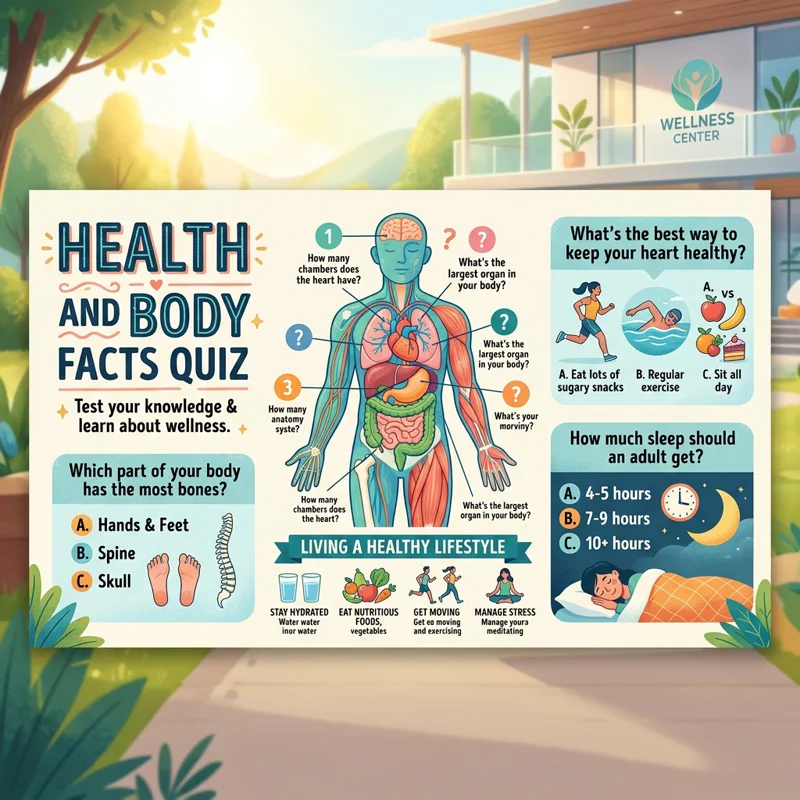
Health & Body Facts Quiz
'You only use 10% of your brain' is almost certainly false. Brain imaging studies using fMRI and PET scans consistently show activity across virtually all brain regions, including during sleep. The myth's origin is unclear - it may derive from a misquote of psychologist William James, an early misinterpretation of glial cell research, or self-help literature that needed a flattering story about untapped potential. No neuroscientist has produced evidence for it. Essentially all of your brain is in regular use.
For entertainment and general awareness only. This quiz is not a medical assessment and cannot diagnose any condition. If you have concerns about your health or mental well-being, please consult a qualified healthcare professional.
'Cracking your knuckles causes arthritis' is also unsupported. Physician Donald Unger spent 60 years cracking only his left hand's knuckles as a controlled experiment; he found no difference in arthritis development between hands. 'Reading in dim light damages your eyes' causes temporary eye strain but no permanent damage. 'We have five senses' is a simplification - the scientific consensus recognises between 9 and 21 distinct human senses, depending on classification.
True facts about the body that sound implausible: your small intestine is approximately 6 metres long - longer than a giraffe is tall - and its unfolded interior surface area would cover a tennis court. The human liver performs over 500 distinct functions and is the only internal organ capable of complete regeneration from as little as 25% of its original mass. Every second, your bone marrow produces approximately 2 million new red blood cells.
This quiz covers 12 questions about human anatomy, physiology, and the biology of how your body actually works - including several answers that contradict common health mythology.
Key Takeaways
- •The human brain contains approximately 86 billion neurons, each connected to thousands of others - creating an estimated 100 trillion synaptic connections.
- •The human gut contains approximately 100 trillion microorganisms - outnumbering human cells by a ratio of roughly 1.3:1 - collectively called the microbiome.
- •The heart beats approximately 100,000 times per day and pumps around 2,000 gallons of blood through a network of blood vessels that would stretch over 60,000 miles if laid end to end.
- •The liver performs over 500 different functions and is the only internal organ capable of complete regeneration - it can regrow from as little as 25% of its original mass.
- •Humans spend roughly one-third of their lives asleep - and sleep deprivation of more than 72 hours has been shown to cause hallucinations and serious cognitive impairment.
The Human Body by the Numbers
The average adult body contains about 37 trillion cells, 206 bones, 650 skeletal muscles, and approximately 60,000 miles of blood vessels.
The skin is the body's largest organ, covering approximately 2 square meters and weighing about 4 kilograms in adults.
The human digestive system contains about 9 meters of gastrointestinal tract from mouth to anus - and the small intestine alone is about 6 meters long.
Every second, the human body produces approximately 25 million new cells and your bone marrow produces about 2 million red blood cells.
Human Body Facts That Sound Impossible
Your small intestine is approximately 6 meters (20 feet) long - longer than a giraffe is tall - yet fits inside your abdomen due to its coiled structure. If you unfolded all its internal folds and villi, its surface area would cover a tennis court (approximately 260 m²).
The human eye can theoretically distinguish approximately 10 million different colors, but people with tetrachromacy (an estimated 12% of women) have a fourth type of color cone and may distinguish up to 100 million colors. Color perception is far more individual than most people realize.
Bone is a living tissue that continuously remodels itself. Your entire skeleton is replaced (cell by cell) approximately every 10 years, though different bones do this at different rates - ribs renew in about 3 years; femur (thigh bone) takes up to 20 years. The skeleton you have at 30 shares no actual cells with the one you had at 20.
The human brain contains approximately 86 billion neurons, each capable of forming up to 10,000 connections with other neurons. The total number of possible synaptic connections is larger than the number of atoms in the observable universe. Processing speed varies, but electrical signals travel through neurons at up to 120 meters per second.
Frequently Asked Questions
How many bones does the human body have? An adult human body has 206 bones. Infants are born with approximately 270–300 bones, many of which fuse together during childhood and adolescence. The smallest bone is the stirrup (stapes) in the ear at 3 mm long; the largest is the femur (thigh bone).
What organ works the hardest in the human body? The heart works continuously without rest for an entire lifetime. It beats approximately 100,000 times per day, pumping about 7,000 liters of blood. Over a 70-year lifespan, the heart beats roughly 2.5 billion times and pumps approximately 200 million liters of blood.
What percentage of the human body is water? The human body is approximately 60% water by weight in adult men and 55% in adult women (due to proportionally higher body fat). Water percentage is highest in the brain and kidneys (approximately 80%) and lowest in tooth enamel (2–3%). Adequate hydration is essential for virtually every biochemical process in the body.
Comments
Leave a comment