
Which Ancient Civilization Do You Belong In?
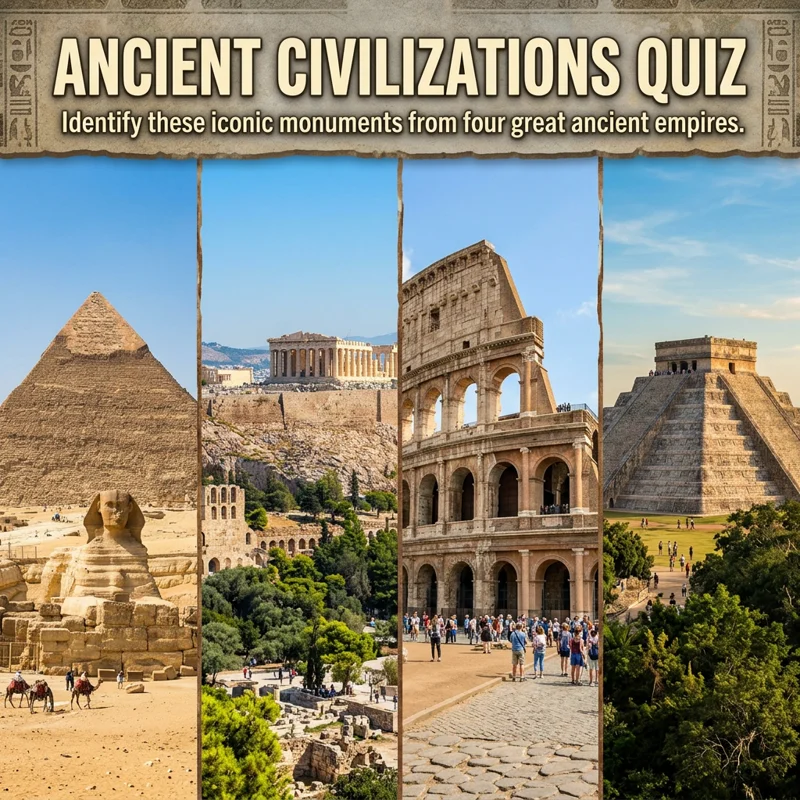
Ancient Egyptian civilization lasted approximately 3,000 years - from the first pharaonic dynasties around 3100 BCE to the Roman conquest in 30 BCE. To calibrate that scale: Julius Caesar and Cleopatra lived closer in time to us than they did to the builders of the Great Pyramid. Egyptian civilization was not ancient to Caesar; it was ancient to Cleopatra. The pyramid was already old when the Parthenon was new.
What made these four civilizations remarkable was not just their duration but their distinct answers to the same fundamental human questions: What deserves to last? What should a society be built around? How should power be organized? Egypt answered with permanence and divine order. Greece answered with reason and public questioning. Rome answered with law and engineering infrastructure. China answered with scholarship, harmony, and the conscious transmission of culture across generations.
Their legacies are embedded in the present in ways that are easy to overlook. Western legal systems trace directly to Rome's Twelve Tables (450 BCE). Western philosophy begins with Socrates and Plato in 5th-century Athens. The paper, printing, gunpowder, and compass that structured modernity all came from China. The Great Pyramid - built without iron tools or modern surveying equipment - remained the world's tallest structure for 3,800 years.
Answer these 10 questions to find out which ancient civilization matches your values and way of being in the world.
Key Takeaways
- •Ancient Egyptian civilization lasted approximately 3,000 years - longer than from Julius Caesar to today - making it one of the most enduring civilizations in human history.
- •Ancient Greece produced foundational works in philosophy, mathematics, medicine, drama, and political theory that directly shaped Western civilization.
- •The Roman Empire at its peak in 117 CE controlled approximately 5 million square kilometers of territory and governed an estimated 70 million people.
- •Ancient China developed paper, printing, gunpowder, and the compass - four inventions that transformed global civilization.
- •The Great Wall, the Pyramids of Giza, the Parthenon, and the Colosseum are all still standing - remarkable testaments to ancient engineering capability.
Four Civilizations, Four Philosophies
Ancient Egypt: Built for the eternal. Every great work - the pyramids, the temples, the hieroglyphs - was designed to outlast the civilization itself. Egyptians believed in order, hierarchy, and the continuation of life after death. They were brilliant engineers and deeply spiritual.
Ancient Greece: Built for the question. The Greeks invented philosophy, democracy, theater, and the Olympic Games. They were passionately curious, fiercely competitive, and deeply concerned with what it meant to live well.
Ancient Rome: Built for the system. Romans were engineers of governance, law, and infrastructure. Their gift to posterity was not beauty or philosophy but the architecture of how a complex society can be organized and sustained.
Ancient China: Built for harmony. Chinese civilization valued order, scholarship, and the cultivation of culture across generations. The civil service, Confucian ethics, and extraordinary achievements in art and invention defined a civilization built to last.
What Each Civilization's Values Can Teach Us Today
Ancient Egypt's obsession with permanence - monuments built to last millennia, bodies preserved for eternity - speaks to a civilization that understood the psychological power of legacy. The desire to leave something lasting is not vanity; it's a recognition that meaning extends beyond a single lifetime.
Ancient Greece gave the modern world democracy, philosophy, theater, and the Olympic Games - but it also normalized debate, public disagreement, and the idea that truth is something you argue toward rather than something handed down. This is the intellectual inheritance that underlies Western science and law.
The Roman Empire's greatest contribution was not military conquest but administrative genius: roads, aqueducts, codified law, and a bureaucratic system that allowed diverse peoples to coexist under a shared framework. Modern governance, legal systems, and infrastructure owe more to Rome than to any other ancient civilization.
Ancient China's emphasis on harmony, balance, and social duty - Confucian ethics, the mandate of heaven, and long-term cyclical thinking - produced one of history's most stable and enduring civilizations. The concept of thinking in terms of generations rather than years remains profoundly relevant.
Frequently Asked Questions
Which ancient civilization was the most advanced? It depends on the metric. Ancient Rome had the most sophisticated administrative and engineering infrastructure; Ancient Greece produced the most lasting intellectual contributions; Ancient China had the most consistent long-term civilization (with the longest continuous history); Ancient Egypt's architectural achievements remain unsurpassed in scale. Each dominated in different domains.
What ancient civilization should I belong to based on personality? Honor and duty-focused personalities tend toward Rome; intellectual and debate-loving personalities toward Greece; legacy and permanence-focused personalities toward Egypt; harmony and community-focused personalities toward Ancient China.
Which ancient civilization had the best quality of life? For elite classes, Rome offered running water, public baths, entertainment, and a sophisticated urban lifestyle. For average citizens, quality of life varied enormously across all civilizations. Ancient China during stable dynasties offered relatively consistent food security and social stability for rural populations.
Comments
Leave a comment