
Famous Inventions Quiz
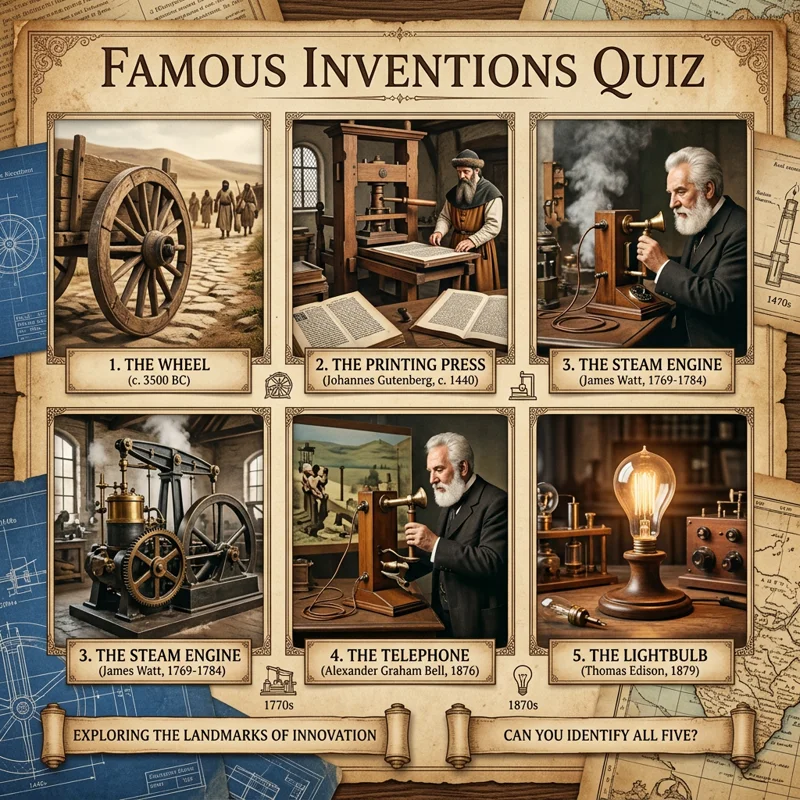
'Who invented the lightbulb?' is one of the most common trivia questions about invention - and the answer is more complicated than Edison. At least 22 inventors produced working incandescent bulbs before Edison's 1879 version. What Edison created was the first practical, commercially viable electric lighting system: not just a bulb, but a generating station, a distribution network, a metered billing system, and a standardized socket. The bulb without the system was useless; Edison built the system.
'Who invented the telephone?' is equally contested. Alexander Graham Bell received US Patent 174,465 on March 7, 1876 - reportedly hours before Elisha Gray filed a competing caveat. The Supreme Court upheld Bell's priority. The invention of radio is also disputed: Nikola Tesla filed patents before Guglielmo Marconi, and the US Supreme Court reversed Marconi's priority in Tesla's favour in 1943 - two years after Tesla's death.
The most consequential invention most people have never heard of is the Haber-Bosch process (1909), which synthesizes ammonia from atmospheric nitrogen to produce artificial fertilizer. Roughly half of all nitrogen atoms in a human body today have passed through this process. Without it, Earth's current population could not be fed - historians estimate Haber-Bosch currently sustains approximately 3.5–4 billion people who would otherwise not survive.
This quiz covers 12 questions across invention history, from Gutenberg's printing press to the smartphone - testing not just who invented what, but what made each invention genuinely transformative.
Key Takeaways
- •Johannes Gutenberg's movable type printing press (c. 1440) is widely considered the most impactful invention of the second millennium - it made mass literacy possible.
- •The World Wide Web was invented by Tim Berners-Lee in 1989 as a way to share information among researchers at CERN - he deliberately chose not to patent it.
- •The steam engine, refined by James Watt in the 1760s, powered the Industrial Revolution and fundamentally changed human economic organization.
- •Edison filed over 1,000 patents in his lifetime, but historians note that many of his 'inventions' were refinements of others' work - particularly the lightbulb.
- •The microprocessor, invented by Intel engineers in 1971, enabled the personal computing revolution by placing the equivalent of a room-sized computer on a single chip.
What Makes an Invention Revolutionary?
The truly transformative inventions don't just solve one problem - they create entirely new categories of possibility. The printing press didn't just print books; it enabled the Reformation, the Scientific Revolution, and modern democracy. The internet didn't just connect computers; it created an entirely new layer of human civilization. The measure of a great invention isn't just what it does, but what it makes possible that was impossible before.
Inventions That Changed Everything - and Their Unintended Consequences
The printing press (1440, Gutenberg) did not just democratize reading - it destroyed the Catholic Church's monopoly on doctrinal interpretation and directly enabled the Protestant Reformation. Within 50 years of its invention, more books were printed than had been produced in the previous 1,000 years. The disruption of established authority that followed reshaped European history for centuries.
The automobile reshaped not just transportation but American urban design, cultural geography, and social behavior. Before the car, American cities were built around walkability and proximity. After the car, suburbs became possible, drive-through culture emerged, and the average American's daily travel radius expanded from approximately 5 miles to 50. The oil industry, the suburb, the highway system, and fast food are all downstream effects of one invention.
Penicillin (discovered by Alexander Fleming in 1928, developed into medicine by Howard Florey and Ernst Chain) is estimated to have saved at least 200 million lives since its clinical introduction in the 1940s. Before antibiotics, bacterial infections from minor wounds were routinely fatal - the average life expectancy gain from antibiotics alone is estimated at 5–10 years.
The contraceptive pill (approved in the US in 1960) is considered by many sociologists to be one of the most socially transformative inventions in human history - enabling women to separate sex from reproduction, pursue education and careers on different timelines, and reshape the demographics of family formation in ways that are still unfolding.
Frequently Asked Questions
What is the most important invention in human history? Different scholars argue for different answers. Fire control and agriculture (prehistoric) enabled civilization itself. The printing press enabled mass literacy. The germ theory of disease (Pasteur, Koch, ~1870s) enabled modern medicine. Electricity and the internal combustion engine enabled industrial modernity. The internet enabled the current information age. The 'most important' depends on your time frame and values.
Who was the greatest inventor in history? Thomas Edison holds the record for most US patents (1,093), but many of his 'inventions' were improvements or commercializations of others' work. Nikola Tesla's contributions to AC electricity, the radio, and early wireless communication were arguably more foundational. Leonardo da Vinci conceptualized the helicopter, solar power, calculator, and plate tectonics centuries before they were realized. The greatest inventor is genuinely contested.
What everyday inventions are less than 100 years old? Sliced bread (1928), the microwave oven (1945), Velcro (1941), the transistor (1947), the barcode (1952), credit cards (1950), the seat belt as a standard car safety feature (1959), and the internet (1969 ARPANET) are all less than 100 years old. Much of modern daily life dates to the mid-20th century.
Comments
Leave a comment