
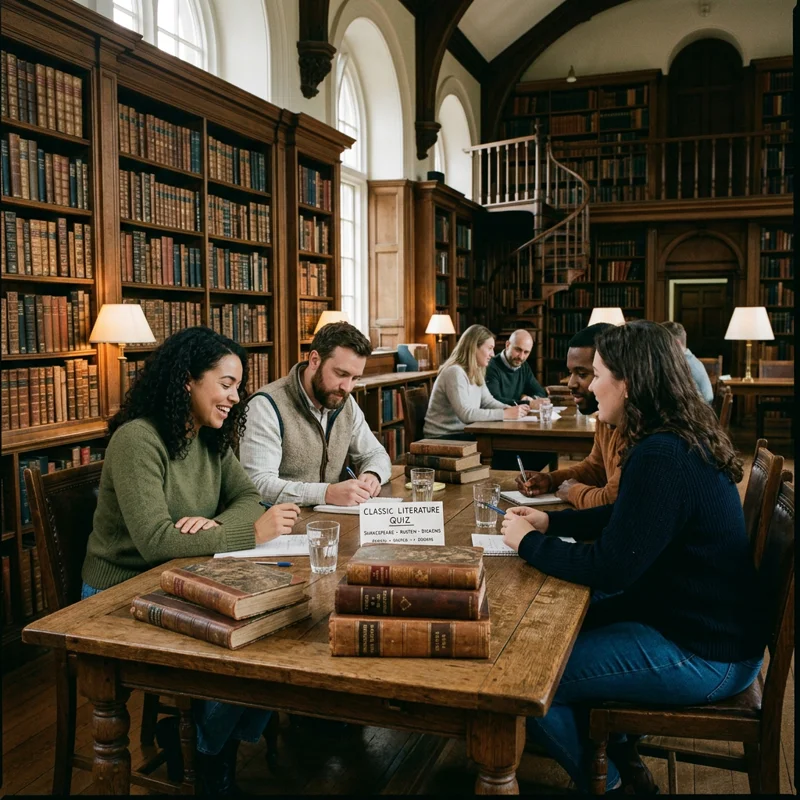
Classic Literature Quiz
'Is Frankenstein the monster?' is one of the most common confusions in literary history - and the answer is no. Frankenstein is the scientist: Victor Frankenstein, a young student who creates an unnamed creature from assembled body parts. Mary Shelley's novel (1818) was written at age 18 during a ghost story competition at Lake Geneva. The creature in the original text is eloquent, philosophical, and deeply lonely - not the grunting, bolt-necked figure of later Hollywood adaptations. The creature asks only for a companion; Victor refuses, and that refusal drives the tragedy.
'What is Shakespeare's most performed play?' Hamlet is staged more frequently than any other Shakespeare work, in more countries and languages than almost any play in history. The title role contains approximately 1,500 lines - nearly 40% of the play's total dialogue. Despite being written around 1600, Hamlet is performed somewhere in the world every single day. Its central question - whether action or paralysis is the greater cowardice - has no clean answer in any production.
'Why does Moby-Dick open with Call me Ishmael?' Not 'My name is Ishmael' - because Ishmael is not necessarily the narrator's real name. The phrase echoes the biblical Ishmael (an outcast), signals unreliability, and establishes the novel's philosophical ambiguity before a single whale appears. Herman Melville published it in 1851; it was a commercial failure that nearly ended his career. He died in 1891 largely forgotten. His literary revival began in the 1920s, and the novel now appears on virtually every 'greatest novels' list.
This quiz covers 12 questions across the English and world literary canon - from Shakespeare and Austen to Dostoevsky and García Márquez.
Key Takeaways
- •William Shakespeare wrote 37 plays, 154 sonnets, and several longer poems in a career spanning roughly 1590–1613 - more than any other author in the English literary canon.
- •Jane Austen published all six of her major novels anonymously, credited only as 'By a Lady.' Her identity was not widely known during her lifetime.
- •Leo Tolstoy's 'War and Peace' contains over 580,000 words and roughly 580 characters - many of them based on real historical figures from Napoleon's 1812 Russian campaign.
- •George Orwell wrote '1984' while dying of tuberculosis on the remote Scottish island of Jura, completing it in 1948 - the title is sometimes attributed to reversing the last two digits of the year.
- •Mary Shelley wrote Frankenstein at age 18, during a ghost story competition with Percy Shelley, Lord Byron, and John Polidori during a stormy summer in Geneva in 1816.
Why Classic Literature Endures
The books that survive centuries do so not because they're assigned in schools - many great books aren't - but because they ask questions and reveal truths that remain relevant regardless of when they were written. Hamlet asks whether action or inaction is the greater cowardice. Anna Karenina asks whether social convention can coexist with emotional truth. Crime and Punishment asks whether guilt requires external punishment or creates its own. These questions haven't aged.
What Classic Literature Actually Gets Right About Being Human
The works that become classics tend to be the ones that accurately diagnose something about human nature that people keep rediscovering. Hamlet's delay isn't a theatrical device - it's a precise portrait of how someone can be paralyzed by the gap between understanding what needs to be done and having the will to do it. Readers in every century recognize this because it's true in every century.
Pride and Prejudice (1813) remains Jane Austen's most read novel not because it's a romance but because it's the most precise account in English literature of how pride (seeing yourself too clearly) and prejudice (seeing others too quickly) distort both thinking and feeling. Austen was writing social psychology 200 years before the field existed.
George Orwell's 1984 (1949) and Animal Farm (1945) were both written from direct observation of totalitarianism - Orwell fought in the Spanish Civil War, witnessed Stalinist purges of socialist allies, and understood how language is weaponized by power. The specific phrases he invented ('doublethink,' 'thoughtcrime,' 'memory hole,' 'Room 101') have entered the English language because they named things that were real.
Dostoevsky's characters are famous for being 'too much' - too passionate, too self-destructive, too philosophically intense. This is not stylistic excess; it's deliberate. Dostoevsky believed that rational, moderate characters couldn't reveal the extremes of human motivation that he considered most important to understand.
Frequently Asked Questions
What classic book should I read first if I've never read classic literature? Jane Austen's Pride and Prejudice is the most common recommendation for classic literature beginners: it's genuinely funny, psychologically sharp, and reads relatively easily compared to Victorian contemporaries. For American classics: The Great Gatsby is short, precise, and densely quotable. For Russian literature: Dostoevsky's Crime and Punishment is the most accessible entry point.
Why is Shakespeare still considered the greatest writer in English? Shakespeare's primacy in English literature is grounded in several factors: the density of his language (more usable phrases per page than any other writer), his psychological complexity (characters that resist simple moral categorization), and the sheer range of his output (comedies, tragedies, histories, sonnets). His plays have been continuously produced, adapted, and translated for 400 years across every culture.
What is the longest novel ever written? Marcel Proust's In Search of Lost Time (À la recherche du temps perdu) is the longest novel widely regarded as a literary masterpiece, at approximately 1.5 million words across 7 volumes. Artamène, ou le Grand Cyrus (1649–1653) is technically longer at 2.1 million words, but is not widely read or studied today.
Comments
Leave a comment