
Science & Nature Trivia Quiz
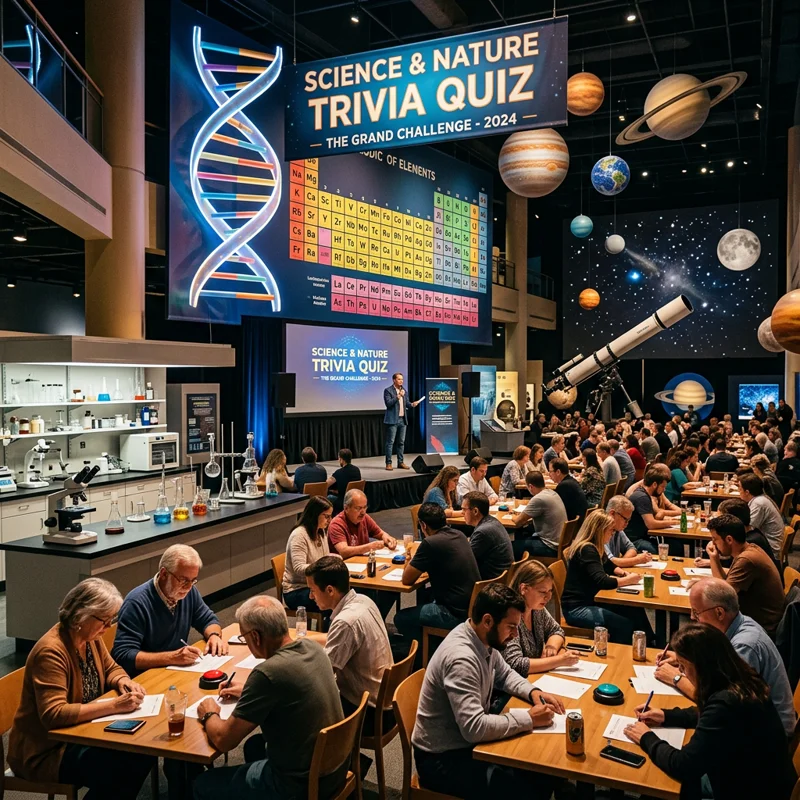
When Watson and Crick published the structure of DNA in Nature in April 1953, their paper ran to just two pages. The final sentence - 'It has not escaped our notice that the specific pairing we have postulated immediately suggests a possible copying mechanism for the genetic material' - is one of the great understatements in scientific history. They were announcing, with deliberate restraint, that they had just figured out how life copies itself.
Modern science moves at a pace that makes even recent discoveries feel routine. The Human Genome Project took 13 years and $2.7 billion to sequence the first human genome, completing in 2003. By 2023, a human genome could be sequenced in under a day for less than $1,000. The James Webb Space Telescope, launched in December 2021, captured images of galaxies forming less than 300 million years after the Big Bang - 13.5 billion years ago. These are not approximations; they are things that have been measured.
What connects Aristotle classifying animals in 350 BCE to the physicists who confirmed the Higgs boson at CERN in 2012 is the same underlying method: observe, hypothesize, test, revise. Science is not a collection of facts. It is the most reliable process humans have developed for discovering what is actually true - as distinct from what is conventional, intuitive, or politically convenient.
Twelve questions spanning physics, biology, chemistry, and astronomy. How much do you actually know about how the world works?
Key Takeaways
- •The human body contains approximately 37 trillion cells - more than all the stars estimated in the Milky Way galaxy.
- •Water is one of the very few substances that expands when it freezes, making ice less dense than liquid water - a property crucial for aquatic life.
- •DNA was first identified in 1869 by Friedrich Miescher, but its double-helix structure wasn't discovered until Watson and Crick's 1953 paper.
- •The speed of light in a vacuum is exactly 299,792,458 metres per second - one of the few physical constants defined by international agreement.
- •Photosynthesis converts roughly 130 billion metric tons of carbon into living matter each year, making it the engine of nearly all life on Earth.
Science as Reliable Method, Not Just Facts
Scientific literacy isn't just for lab coats. Understanding basic biology, physics, and chemistry helps you evaluate health claims, understand climate debates, assess vaccine information, and make better decisions in everyday life. The gaps in public scientific understanding - what viruses are, how vaccines work, what atoms are - have real consequences. Trivia is a fun way to close those gaps.
The Most Surprising Science Facts
Bananas are naturally radioactive due to their potassium-40 content. You'd need to eat about 5 million bananas to receive a fatal dose - so finish your fruit.
A bolt of lightning is five times hotter than the surface of the sun. The sun's surface is about 5,500°C; a lightning channel reaches around 30,000°C.
Octopuses have three hearts and blue blood - the blue color comes from hemocyanin, a copper-based oxygen carrier instead of hemoglobin.
If you removed all the empty space from atoms in the human body, all of humanity's mass would fit in a sugar cube.
Frequently Asked Questions
What science facts should everyone know? The most practically useful science facts: vaccines work through immune system training, not toxin injection (the immunity/herd immunity principle); evolution is the organizing framework of all modern biology (not a 'theory' in the colloquial sense - 'theory' in science means a well-supported explanatory framework); climate change is driven by greenhouse gas accumulation (this is measured, not modeled); and antibiotics work on bacteria, not viruses (the distinction matters for treatment).
What is the hardest science trivia question? Questions that routinely stump even science-literate people: How many cells are in the human body? (~37 trillion); What is the speed of light in km/s? (299,792 km/s); What percentage of DNA do humans share with bananas? (~60%, because basic cellular machinery is ancient and conserved); How old is the universe? (approximately 13.8 billion years, measured via cosmic microwave background radiation).
Why is science literacy important? Science literacy enables citizens to evaluate health information (vaccines, nutrition, medications), understand environmental issues (climate, pollution, biodiversity), and assess technological risks and benefits (AI, GMOs, nuclear energy). Research consistently finds that scientifically literate populations make better health decisions and are less susceptible to misinformation.
Comments
Leave a comment