
90s Nostalgia Trivia Quiz
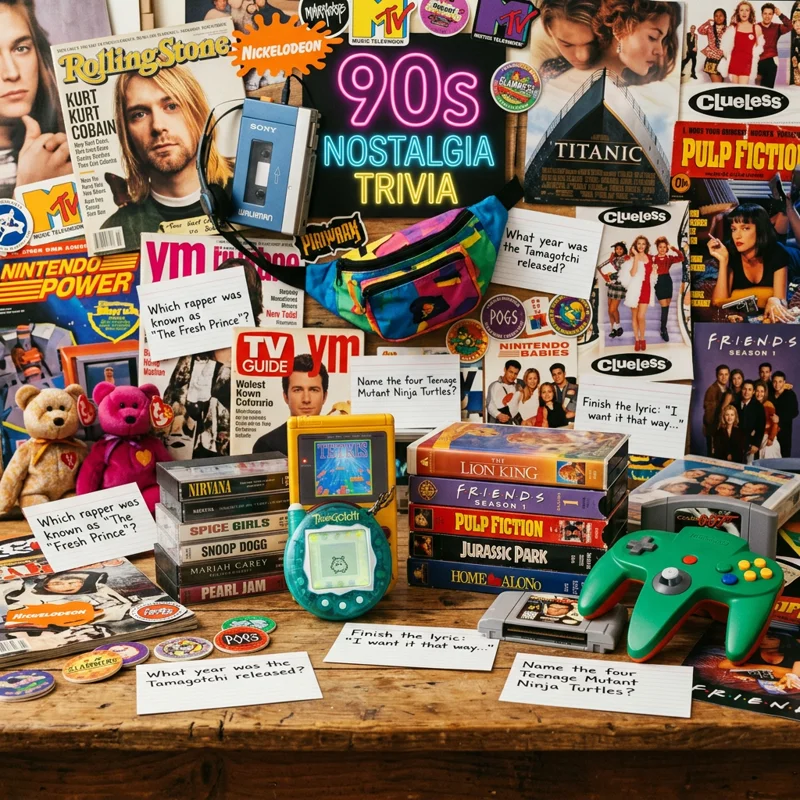
Here is a thing people consistently misremember about the 1990s: the World Wide Web wasn't the internet. The internet - the underlying network infrastructure - had existed since 1969 as ARPANET. The Web, invented by Tim Berners-Lee at CERN in 1989 and opened to the public in 1991, was the interface layer that made the internet accessible to non-engineers. By 1995, Amazon, Yahoo, and eBay had launched. By 1999, there were over 15 million websites. The decade didn't give us the internet; it gave us the internet as a daily human experience.
The 90s were the last decade of genuine analog-digital coexistence. People had pagers and fax machines and AOL dial-up simultaneously. The screech of a modem connecting was the sound of a decade in transition. You could go entire days without your phone. Movies were taped on VHS. The Seinfeld series finale in 1998 drew 76 million viewers because there was no other way to watch it - no streaming, no DVR, no catch-up. You showed up at 9pm or you missed it.
Culturally, the decade was unusually fragmented and unusually coherent at the same time. Grunge, boy bands, R&B, and hip-hop were all simultaneously mainstream. Toy Story (1995) was the first entirely computer-animated feature film; its existence announced that Hollywood would never look the same. The Spice Girls' debut single 'Wannabe' (1996) reached number one in 37 countries - the best-selling debut single by an all-female group at the time. It was genuinely strange.
Twelve questions on the decade that built the world we live in now. How much do you actually remember?
Key Takeaways
- •The World Wide Web was opened to the public in 1991, and by 1999 had grown to over 15 million websites - the internet as we know it was largely born in the 90s.
- •The Tamagotchi, released by Bandai in 1996, sold over 76 million units globally and pioneered the concept of digital pet maintenance.
- •Nirvana's 'Smells Like Teen Spirit' (1991) is widely credited with bringing alternative rock into the mainstream and defining the grunge aesthetic.
- •Friends premiered in 1994 and became the defining sitcom of the decade, influencing everything from fashion to cultural vocabulary.
- •Toy Story (1995) was the first feature-length film made entirely with computer-generated imagery, produced by Pixar Animation Studios.
The Last Decade Before the Algorithm
Every decade carries nostalgia for those who lived through it, but the 90s have a particular cultural staying power. It was the last decade before the internet reshaped daily life - the last era when phone calls were planned, TV shows had to be watched live or taped, and shopping happened in malls. The combination of analog warmth and early digital excitement created a bittersweet quality that Gen X and Millennials still feel acutely.
Why the 90s Feel So Different in Memory
The 1990s were the last decade before the internet reshaped daily life - which means 90s memories carry a particular texture: boredom, physical presence, limited information, and a genuine sense that what was on TV on Thursday night mattered to almost everyone you knew.
Nostalgia researchers (including Constantine Sedikides at the University of Southampton) have found that nostalgic memories reliably boost mood, increase feelings of social connection, and restore a sense of meaning - which explains why 90s nostalgia has proved so commercially durable across multiple decades.
The 90s also produced a generation of cultural touchstones that aged unusually well: The Fresh Prince of Bel-Air, Nirvana, Seinfeld, Toy Story, and the first generation of video games with genuine narrative depth. These weren't just popular - they were formative in a way that required shared simultaneous experience, which is increasingly rare.
Frequently Asked Questions
What are the most iconic 90s cultural moments? The most frequently cited: the release of Nirvana's Nevermind (1991), the premiere of Friends (1994), the debut of Toy Story (1995 - the first fully computer-animated feature film), the Tamagotchi craze (1996), and the finale of Seinfeld (1998, watched by 76 million people). In tech: the launch of Google (1998) and Amazon (1994).
What music defined the 90s? The 90s spanned multiple defining genres simultaneously: grunge (Nirvana, Pearl Jam), R&B (TLC, Destiny's Child, Aaliyah), pop (Backstreet Boys, Britney Spears, NSYNC), hip-hop (Tupac, Biggie, Jay-Z), and alternative rock (Radiohead, Alanis Morissette, Green Day). It was one of the most musically diverse decades in pop history.
What TV shows defined the 90s? Friends, Seinfeld, The Fresh Prince of Bel-Air, The X-Files, Buffy the Vampire Slayer, Frasier, and ER were the defining network shows. In kids' TV: Rugrats, Hey Arnold, Animaniacs, and The Simpsons (in its peak years). Saturday morning cartoons were still a genuine cultural ritual.
Comments
Leave a comment