
Which Planet Matches Your Personality?
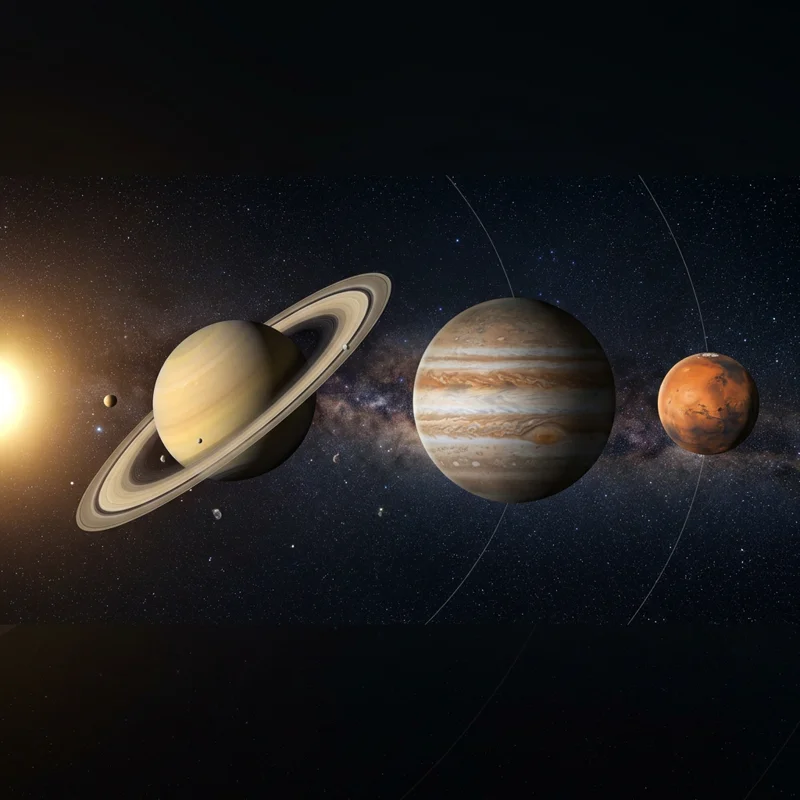
The five planets visible to the naked eye - Mercury, Venus, Mars, Jupiter, and Saturn - were named by ancient Roman astronomers after their gods based on observed qualities. Mars moved quickly and glowed blood-red. Venus outshone everything in the night sky except the moon, soft and brilliant. Jupiter was the largest and most majestic. The naming was not arbitrary: over millennia of observation, ancient astronomers across the world independently assigned these planets personalities that turned out to be surprisingly apt physical metaphors.
Mars really is volatile and scarred by global dust storms and ancient impact craters. Venus really does have an intensely hot interior beneath a deceptively bright surface - its surface temperature averages 465°C, hot enough to melt lead, driven by a runaway greenhouse effect. Jupiter really does exert a gravitational pull that deflects asteroids and comets that would otherwise threaten the inner planets. Saturn really does move more slowly than all other visible planets; its year takes 29.4 Earth years. The ancients read personality from behavior. The physics, when we finally measured it, matched.
Neptune, discovered in 1846 and never visible to the naked eye, has the strongest winds in the solar system - reaching 2,100 km/h - despite receiving so little solar energy that it generates most of its heat internally. Uranus orbits the sun on its side, its axis tilted 98 degrees, for reasons that remain partially debated. Even the least-known planets have distinct characters, earned through 4.6 billion years of physical history.
Answer these 10 questions to find out which planet is your cosmic match.
Key Takeaways
- •Ancient astrology named the five visible planets after Roman gods - Mars (war), Venus (love), Jupiter (king), Saturn (agriculture/time), and Mercury (messenger) - based on their observed qualities.
- •Saturn's rings are made primarily of ice and rock, ranging from tiny grains to objects as large as houses, and span up to 282,000 km in diameter.
- •Mars has the largest volcano in the solar system - Olympus Mons - standing 21 km high and nearly three times the height of Mount Everest.
- •Neptune's winds are the strongest in the solar system, reaching speeds of 2,100 km/h - despite the planet receiving very little solar energy.
- •Jupiter acts as a 'cosmic vacuum cleaner' - its massive gravity attracts and absorbs many asteroids and comets that would otherwise threaten the inner planets.
The Planets as Personality Archetypes
Mars: The warrior, the achiever, the one who goes after what they want without apology. Bold, direct, and driven by desire. High energy, quick to ignite.
Venus: The lover, the artist, the one who finds beauty everywhere and wants to share it. Warm, sensory, and oriented toward connection and pleasure.
Jupiter: The generous giant - expansive, optimistic, and a natural leader and mentor. Sees the big picture; makes others feel bigger for being near them.
Saturn: The wise elder - structured, disciplined, and patient. Values what endures over what dazzles. Takes time to trust; rewards the same.
Mercury: The quick thinker - communicative, adaptive, and intellectually restless. Always moving, always transmitting, always finding a new angle.
Neptune: The dreamer - mysterious, creative, empathic, and attuned to what's beneath the surface. Sees what others miss.
Uranus: The rebel - unpredictable, original, and ahead of its time. Marches alone and somehow turns out to have been right.
Earth: The home - balanced, life-giving, adaptable, and quietly extraordinary. The one that makes everything possible.
The Science Behind Each Planet's Personality
Mercury - the swift messenger planet closest to the Sun - completes an orbit in just 88 days. In personality terms, Mercury people are quick-thinking, communicative, and perpetually in motion. The planet's extreme temperature swings (430°C in daylight, -180°C at night) mirror the intellectual versatility and inconsistency that Mercury personalities are known for.
Venus - the hottest planet in the solar system despite not being closest to the Sun, due to its thick CO₂ atmosphere - is associated with beauty, pleasure, and intensity. Its surface is volcanic and extreme; its appearance from Earth is the brightest object in the night sky after the Moon. Venus personalities combine outward brilliance with hidden intensity.
Mars - the Red Planet, named for the Roman god of war - has the largest volcano and longest canyon in the solar system. It's a world of extremes: dust storms that engulf the entire planet, ice caps at both poles. Mars personalities are driven, sometimes volatile, and capable of sustained effort in harsh conditions.
Jupiter - the solar system's largest planet, with a storm (the Great Red Spot) that has raged for at least 350 years - represents expansion, ambition, and philosophical largeness. Jupiter personalities think big, see the long view, and are energized by ideas of scale and meaning.
Saturn - ringed, methodical, the slowest of the classical planets - represents structure, discipline, and the long game. Saturn's rings are made of ice and rock, perfectly ordered in orbit. Saturn personalities value order, earn their results over time, and tend toward depth rather than breadth.
Frequently Asked Questions
Which planet has a personality most like mine? Take the quiz above to find your planetary match. In astrological and personality frameworks, the key factors are pace (Mercury = fast; Saturn = slow), social energy (Venus = relational; Mars = independent), and orientation (Jupiter = expansion; Saturn = consolidation).
What planet has the most extreme conditions? Venus holds the record for most extreme surface temperature (averaging 465°C / 869°F - hot enough to melt lead), while Neptune has the strongest winds in the solar system at over 2,100 km/h. Jupiter has the largest storm (the Great Red Spot) and Mars has the tallest volcano (Olympus Mons at 21.9 km).
Is Pluto a planet? Pluto was reclassified as a 'dwarf planet' by the International Astronomical Union in 2006 because it has not 'cleared the neighborhood' around its orbit - one of the three criteria for full planetary status. It remains a dwarf planet alongside Eris, Haumea, Makemake, and Ceres.
Comments
Leave a comment