
90s Music Trivia Quiz
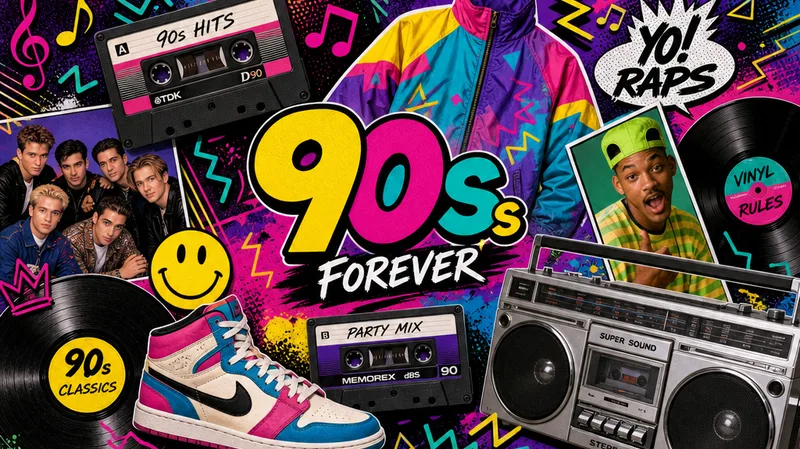
The 1990s were a seismic decade for music. Grunge exploded out of Seattle and killed the hairspray era overnight. Hip-hop found its commercial voice and became the dominant cultural force it remains today. Britpop turned Liam and Damon into national symbols. The Spice Girls made girl power a mainstream slogan. TLC, Mariah Carey, Boyz II Men, and R. Kelly defined the sound of urban radio. And then, quietly, a generation of indie acts were reshaping what rock could sound like.
The 90s also gave us Napster, CD culture at its commercial peak, and the last era before streaming fractured the shared listening experience. Everyone had the same albums on their shelves. Radio still mattered. A #1 single actually meant something. This was music before the algorithm.
12 questions. How well do you really know the decade that changed everything?
Key Takeaways
- •Nirvana's 'Nevermind' was released in September 1991 and within weeks had pushed Michael Jackson's 'Dangerous' off the #1 spot on the Billboard 200 - a symbolic handover of cultural power.
- •The Spice Girls are the best-selling girl group of all time, with over 100 million records sold worldwide.
- •Mariah Carey and Boyz II Men's 'One Sweet Day' held the Billboard Hot 100 #1 spot for 16 consecutive weeks in 1995–96 - the longest-running #1 of the decade.
- •TLC's 'CrazySexyCool' (1994) became the best-selling album by a US girl group of all time, certified diamond (10× platinum) by the RIAA.
- •Tupac Shakur and The Notorious B.I.G. were both killed in 1996 and 1997 respectively - losses that marked the end of hip-hop's golden age and shifted the genre's centre of gravity toward the South and Midwest.
The Sound of the 90s
The 90s are defined sonically by contrast: the abrasive distortion of grunge against the polished sheen of pop, the boom-bap percussion of East Coast hip-hop against the G-funk of the West Coast, the jangly guitars of Britpop against the ethereal haze of trip-hop. No single genre dominated - the decade was pluralistic in a way the 80s, with its MTV monoculture, never was. That pluralism is why 90s music still sounds alive. There was always a counter-movement, always someone making something the mainstream hadn't caught up to yet.
Genres That Defined the Decade
Grunge emerged from Seattle's underground scene and hit mainstream consciousness with Nirvana's 'Nevermind' (1991). Pearl Jam, Soundgarden, and Alice in Chains followed. By 1994 - the year Kurt Cobain died - grunge was already being repackaged as post-grunge by labels, but the original moment was electric and brief.
Hip-hop's golden age in the late 80s and early 90s produced some of the most critically acclaimed rap albums ever made. Public Enemy, De La Soul, A Tribe Called Quest, Wu-Tang Clan, Nas, Jay-Z, and The Notorious B.I.G. all released landmark work in this period. The East Coast/West Coast rivalry - centred on Tupac and Biggie - defined the mid-90s and ended in tragedy.
Britpop was a British response to American grunge - melodic, guitar-driven, and explicitly nostalgic for a certain idea of Englishness. Oasis and Blur were its defining acts; the Blur vs. Oasis chart battle of August 1995 was the last time a singles release was treated as a genuine cultural event.
Teen pop arrived in the late 90s via the Backstreet Boys, *NSYNC, Britney Spears, and Christina Aguilera - a commercial machine that sold hundreds of millions of records and set the template for manufactured pop that persists today.
R&B and hip-hop soul produced 'Waterfalls' (TLC), 'End of the Road' (Boyz II Men), and Mariah Carey's entire catalogue of melodic excess - music that was technically mainstream but often more vocally ambitious than anything in rock.
Frequently Asked Questions
What was the best-selling album of the 90s? Michael Jackson's 'Thriller' technically sold more in the 90s as a back catalogue item, but for new 90s releases, Shania Twain's 'Come On Over' (1997) is one of the best-selling albums of the decade at 40 million copies worldwide. Alanis Morissette's 'Jagged Little Pill' (1995) is one of the best-selling debut albums in history.
Who was the biggest 90s artist? Depending on the metric: Mariah Carey (most Billboard #1 singles of the decade), Backstreet Boys (best-selling boy band), TLC (best-selling US girl group), or Nirvana (most culturally disruptive). The 90s had no single dominant artist in the way Michael Jackson owned the 80s.
What killed grunge? Kurt Cobain's death in April 1994 is the symbolic answer, but the real answer is more commercial: labels signed every Seattle-adjacent act they could find, diluting the scene. Post-grunge acts like Nickelback and Creed arrived within a few years, stripping the genre of its abrasion while keeping the sonic template. The original had burned too bright and too fast.
Comments
Leave a comment