
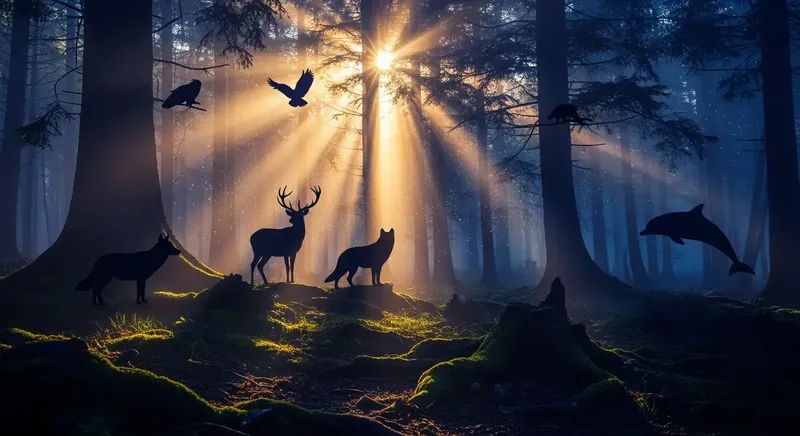
What Is a Spirit Animal?
The term 'spirit animal' has roots in Indigenous spiritual traditions across many cultures, where animals are understood as spiritual guides, protectors, or teachers that carry symbolic meaning and offer wisdom to human beings. In these traditions - which vary enormously across different Indigenous nations - the relationship with an animal guide is a sacred and personal one, often revealed through ceremony, vision, or life experience.
In contemporary Western popular culture, the concept has been largely reframed as a secular tool for self-reflection. Carl Jung's analytical psychology contributed to this shift: Jung described 'archetypes' - recurring symbolic figures in the collective unconscious - and many of these archetypes take animal form. The lion as strength, the serpent as transformation, the owl as wisdom appear across mythologies worldwide, and Jung saw this cross-cultural consistency as evidence of shared psychological structures.
It is worth noting the respectful distinction between sacred Indigenous spiritual practice and the secular, entertainment-oriented use of animal symbolism in personality contexts. When personality quizzes ask 'what is your spirit animal?', they are drawing on the pop-psychology version of the concept - not making claims about Indigenous traditions. Treating the two as equivalent flattens real cultural meaning.
The Psychology Behind Animal Identification
Why do people feel a strong personal connection to particular animals? Several psychological mechanisms contribute. Projection is one of the most significant: when we see an animal and feel kinship with it, we are often projecting our own traits, aspirations, or self-concept onto that animal. The wolf does not actually embody loyalty and independence in any psychological sense - but we can use the wolf as a mirror for our own values.
Symbolic thinking is another factor. Humans are uniquely powerful symbolic thinkers, capable of loading objects, animals, and images with layered meaning. This is not irrational - it is one of the most distinctively human cognitive capacities. Animals make excellent symbols because they are complex, familiar, and universally encountered across cultures.
The Barnum Effect - the tendency for people to accept vague, broadly applicable personality descriptions as uniquely accurate - also plays a role in why 'what animal are you?' results feel personally meaningful. If you are told that your spirit animal is the fox - clever, adaptive, curious, and sometimes misunderstood - it is likely that many of those traits feel accurate to you, not because the quiz is insightful, but because those traits are widely applicable.
Common Animal Archetypes and What They Represent
Certain animals appear repeatedly as personality archetypes across cultures and quiz traditions. The wolf is associated with loyalty, intelligence, and strong social bonds within a pack - traits corresponding to high agreeableness and extraversion within Big Five terms. The owl symbolizes wisdom, quiet observation, and nocturnal depth - mapping broadly onto openness and introversion. The fox represents adaptability, cunning, and resourcefulness - traits associated with high conscientiousness combined with low agreeableness in some frameworks.
The bear archetype encodes strength, groundedness, protective instincts, and a preference for solitude - resonating with individuals who score high on stability and low on sensation-seeking. The eagle symbolizes vision, independence, leadership, and a high-altitude perspective - often applied to individuals with strong goal orientation and executive function. The dolphin, highly social and playful, is associated with emotional intelligence, joy, and interpersonal warmth.
These archetypes are useful as starting points for self-reflection, not as scientific categories. They encode cultural values as much as psychological ones, and the same person might identify with different animals depending on context - who they are at work versus with family, or who they aspire to be versus who they feel they currently are.
Animal Symbolism Across Cultures
One of the most important things to understand about animal symbolism is that it is not universal - the same animal carries very different meaning across traditions. The owl, seen in Western culture as a symbol of wisdom, is an omen of death in some Indigenous Mexican and African traditions. The snake represents wisdom and healing in ancient Greek medicine (the caduceus) and pure temptation and evil in Judeo-Christian tradition.
In East Asian cultures, the dragon is a fundamentally positive symbol - of imperial power, good luck, and benevolent strength - while in Western medieval traditions, the dragon typically represents destructive chaos to be overcome. The tiger, revered as a symbol of courage and protection in many East Asian traditions, carries different connotations in different South Asian contexts.
This cultural variability matters for two reasons. First, it undermines the idea that any animal archetype has a fixed, objective meaning. Second, it highlights that when personality quizzes assign an animal to you, they are working from a particular cultural tradition - usually a blend of Western and global pop-culture symbolism - not from any universal psychological truth.
What Your Favorite Animal May Reveal
Psychologist Samuel Gosling and colleagues have conducted some of the most rigorous research on human-animal relationships and personality. Their work on pet ownership and Big Five personality traits found meaningful correlations: dog owners tend to score higher on extraversion and agreeableness, while cat owners tend to score higher on openness to experience and neuroticism. These are statistical tendencies, not rules - and they reflect the interaction between personality and choice of companion, not any inherent animal meaning.
Research on human-animal identification more broadly suggests that the animals people feel drawn to often reflect their self-concept - particularly their ideal self rather than their current self. People who identify strongly with wolves often value the traits the wolf symbolizes (loyalty, independence, social intelligence) rather than necessarily demonstrating all of them in their daily behavior. This is not self-delusion - it is identity aspiration, which is a psychologically meaningful and normal phenomenon.
The more interesting question may not be 'what animal are you?' but 'what does your animal identification tell you about your values and aspirations?' Approached that way, animal personality quizzes can serve as a productive prompt for reflection - as long as the results are treated as starting points, not verdicts.
Research Note
Samuel Gosling's work on pet ownership and personality (Big Five correlates) found systematic links between the pets people choose and their personality profiles - a finding that suggests animal identification may reflect genuine self-concept rather than random preference.
Frequently Asked Questions
Is there scientific evidence for spirit animals? The concept of a 'spirit animal' as a fixed psychological identity is not a recognized construct in empirical psychology. However, the underlying phenomena - projection, symbolic thinking, and human-animal identification - are well-studied. Research supports that humans form meaningful psychological bonds with animal symbols and that preferred animals often correlate with self-concept and values.
What does it mean if I identify with a predator vs. a prey animal? Personality research does not support the idea that predator identification maps to dominance traits or prey identification to submissiveness. People identify with animals across the predator/prey spectrum based on the full range of symbolic meanings those animals carry in their cultural context - not based on ecological role.
Can your spirit animal change over time? Yes - and this is psychologically coherent. If your spirit animal reflects your current self-concept, values, or aspirations, it would naturally shift as you change. Major life transitions, periods of growth, or significant relationships often bring shifts in the animal archetypes that feel personally resonant.
Discover Your Animal Personality
Animal personality quizzes sit at the intersection of cultural symbolism, pop psychology, and genuine self-reflection. The Animals category on this site includes quizzes on everything from which animal you most resemble to specific breed-level personality matches - all approached in the spirit of enjoyable, low-stakes exploration.
The most productive use of any animal personality quiz is to treat the result as a conversation starter with yourself: does this resonate? What does it say about what I value? Where does it miss? That reflective engagement is where entertainment becomes genuinely useful.